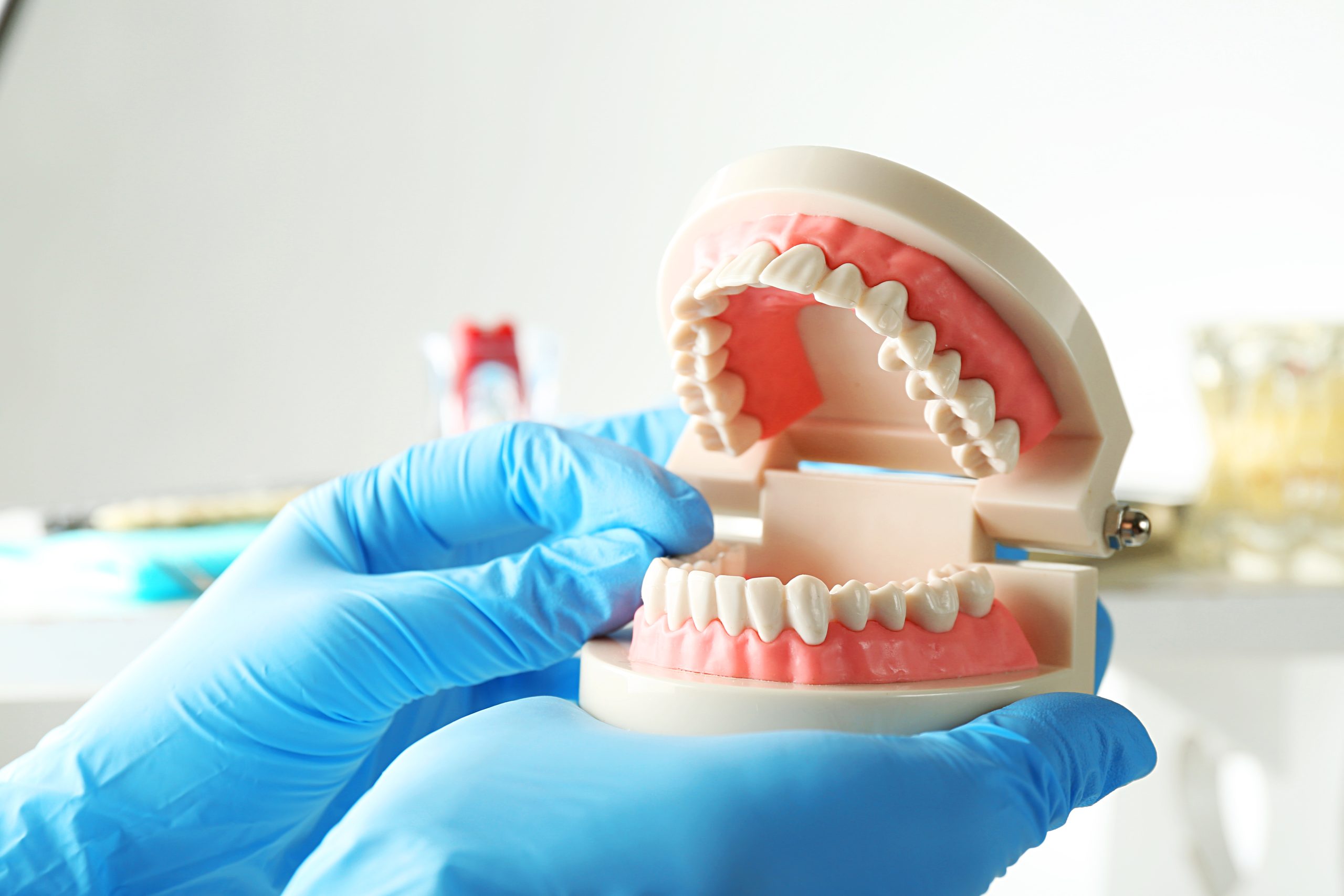








The All-on-4® treatment concept and traditional dental implants are both proven treatment options. The difference is not which one is “better.” The difference is which approach matches the patient’s anatomy, goals, and long-term outlook.
Understanding how these treatments function over time is more important than comparing them at face value.
Traditional Dental Implants
Traditional dental implants replace individual missing teeth or small groups of teeth. Each implant is placed into the jawbone and supports a single crown or a segment of a bridge.
This approach works well when:
- Tooth loss is limited or isolated
- Bone volume is adequate at each implant site
- Adjacent teeth are healthy and stable
- Long-term maintenance can be managed tooth by tooth
Traditional implants preserve normal chewing forces and allow for precise, localized treatment. When conditions are ideal, they offer excellent longevity and flexibility.
Where traditional implants can become less predictable:
- Extensive bone loss across the arch
- Multiple missing or failing teeth
- Long treatment timelines due to grafting
- Repeated surgeries to replace multiple teeth
In these cases, placing individual implants can increase complexity without improving outcomes.
All-on-4 Dental Implants
All-on-4 is a full-arch implant solution that uses four strategically placed implants to support a fixed set of teeth. The implants are angled to maximize existing bone and reduce the need for grafting.
This approach is often considered when:
- Most or all teeth in an arch are missing or failing
- Bone loss is present but concentrated in specific areas
- A faster, more consolidated treatment plan is preferred
- Patients want a fixed solution rather than removable dentures
By distributing forces across the arch, All-on-4 can restore function and stability even when traditional implants would require extensive reconstruction.
Where All-on-4 may not be ideal:
- Limited tooth loss
- Patients who benefit from preserving individual teeth
- Situations where localized implants provide better control
All-on-4 vs Traditional Dental Implants: At-a-Glance Comparison
| Consideration | Traditional Dental Implants | All-on-4 Dental Implants |
| Best suited for | One or several missing teeth | Most or all teeth missing or failing |
| Number of implants | One implant per tooth or segment | Four implants per arch |
| Bone requirements | Adequate bone needed at each implant site | Uses existing bone strategically |
| Bone grafting | Often required when bone loss is present | Often reduced or avoided |
| Treatment scope | Localized, tooth-by-tooth replacement | Full-arch reconstruction |
| Surgical timeline | May involve multiple procedures | Typically one surgery per arch |
| Provisional teeth | Usually delayed until healing is complete | Fixed provisional teeth often placed same day |
| Maintenance | Managed per implant or crown | Maintained as a single fixed unit |
| Future repairs | Individual components can be addressed | Arch-level repairs require coordinated care |
| Long-term predictability | High when bone and bite are stable | High when case selection is appropriate |
Bone Loss and Long-Term Stability
Bone loss plays a major role in determining which option holds up over time.
Traditional implants depend on bone quality at each implant site. When bone loss is uneven or advanced, predictability decreases unless grafting is performed.
All-on-4 uses implant angulation and strategic placement to work around areas of bone loss. This often reduces the need for grafting and shortens treatment time, without compromising stability.
Neither approach bypasses biology. Long-term success depends on appropriate case selection.
Maintenance and Longevity
Both options require ongoing care.
Traditional implants:
- Are maintained individually
- Allow isolated repairs if a single implant or crown fails
- Can become complex when multiple implants are involved
All-on-4:
- Is maintained as a single unit
- Simplifies hygiene routines
- Requires professional monitoring of the entire arch
Long-term success for either option depends on oral hygiene, follow-up care, and bite stability.
Surgical Scope and Treatment Timeline
Traditional implants often involve:
- Multiple surgical sites
- Possible bone grafting
- Longer total treatment timelines
All-on-4 typically involves:
- A single surgical procedure per arch
- Fewer implants
- The ability to place fixed provisional teeth the same day in qualified patients
Shorter timelines are not automatically better, but consolidated treatment can reduce overall surgical exposure.
Choosing the Right Option
The decision between All-on-4 and traditional implants is not based on preference or trend. It is based on:
- The number of teeth involved
- Bone anatomy and quality
- Medical considerations
- Long-term functional goals
In some cases, traditional implants offer the most conservative solution. In others, All-on-4 provides greater stability with fewer compromises.